


PARIS – Josef Aschbacher, the head of the European Space Agency, said member states are quickly changing how they view space, from its role in geopolitics, to the need for sovereign capabilities to working more closely with their national security counterparts.
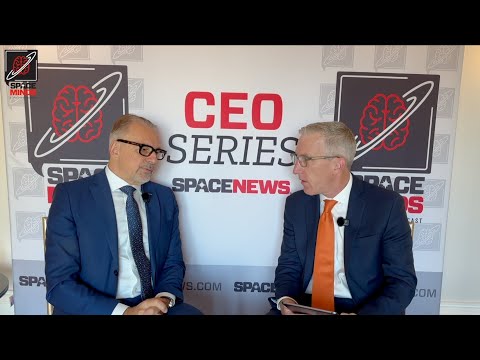
During a Sept. 15 interview here at World Space Business Week, Aschbacher, the agency’s director general, discussed ESA’s agenda and the ambitious budget negotiations ahead of November’s ministerial conference. He also talked about the importance of an ongoing launch competition and the need to deepen commercial partnerships.
The following excerpt has been edited for brevity and clarity.
Editor’s note (Sept. 29, 2025): This article has been updated to include more of the interview.
SpaceNews: How do you make the case to Europe’s leaders for investing in space?
Josef Aschbacher: We are having a ministerial conference this year in November in Bremen, in Germany. And there, I will talk a lot to decision makers: sometimes heads of government, heads of state, or the ministers in charge of space, to really explain the case. I boil it down to two simple arguments.
One is space is a very interesting economic sector. It grows by about 10% per year. We have a space economy of about 500 billion, 600 billion euros. And this grows to 1.8 trillion, which is the figure very often quoted. So if you just extrapolate these figures, it’s about nine to 10% per year of the global space economy.
So space is, purely from an economic perspective, extremely interesting and extremely convincing as an argument. Plus, if you invest one euro in space, we estimate that about five to seven euros come back into the economy through new services, taxes and new businesses that are being developed.
What’s the other?
The other argument that has really come on extremely strong just recently is geopolitics. Space is a tool of geopolitics. We see it extremely clearly in the United States, but also in China and Russia and other countries, and also in Europe. For the last couple of months, really, we have had a very different debate on how space can be useful for countries to build up strength and to build up strength in defense, to couple defense and space much better. Member states have asked me to come with very concrete proposals on how to utilize our space assets much more for security and defense.
What does that look like?
There will always be dual-use technology. I take a very simple example: meteorology. We are building meteorological satellites. There’s not a military meteorological satellite and a civilian one. It’s one type of satellite, and then the data streams go civilian and defense.
In the past, as the European Space Agency, we’ve been mostly focusing on science, civilian application, civilian programs. But on the defense side, [we have] some more defense-related programs. We are really catching up.
Globally of the space budget, it’s about 50% defense funding and 50% civilian funding, except in Europe, where the share is only 15%. In Europe, the defense ministries are allocating a much lower share to space. And that’s something that is expected to change very fast. The debate with my member states today is a very different debate compared to half a year ago or one year ago.
Let’s talk about Bremen. You’ve proposed a three-year budget of roughly 22–23 billion euros. Where is there room for ambition, and where are the risks?
It’s a very intense negotiation with all our member states. Our job is to find an agreement; that we have a proposal that is as attractive for Greece as it is for France or Germany or any other country.
A priority is always Earth observation but also navigation, telecommunications, especially secure communication, and also satellite based internet signals. Exploration is something that keeps increasing, quite significantly. Of course we have a strong cooperation with NASA but also our own programs for low Earth orbit, the moon, Mars and beyond. And launchers. We have a very strong launcher program with Ariane 6 now back on the launch pad. Plus we have a new family of launchers that we call the European Launcher Challenge, which is a completely new set of smaller launchers. They will start as smaller launches but some will become heavy launchers.
Plus a new element that comes now on top, which is more defense related. There’s a program called ERS — European Resilience from Space — I would call it a surveillance and intelligence program building up a very high-resolution constellation of radar, optical infrared sensors with intelligence on board, with edge computing on board, interlinked through satellite communication. This is something that’s in the making. We are really on day one of building up this program, but it’s certainly quite exciting.
That will be a low Earth orbit constellation? A proliferated constellation, dozens or hundreds of satellites?
Certainly large numbers with a very high observation frequency every day, roughly every 30 minutes as a target. Not only with optical, but with radar, infrared, in order to really have a holistic view of any place in the world. I’m putting a proposal on the table for funding in November, and then we have to see how strong the funding is. We have shown that we are capable of creating and developing complex systems. We can do it. But of course we are, in this ERS program, really at the very beginning.
You mentioned the European Launcher Challenge. What’s the status of the 12 companies for the program you initially selected?
We actually already boiled it down to five. Of those five, not all of them will make it to become a heavy launcher. What we are doing now is we are looking for funding for those five. We will act — as ESA — more as an anchor tenant, so we let them develop whatever technology they feel is more appropriate with whatever partner they feel is most supportive. But we will buy launch services and support some of the infrastructure development. It’s a new way of doing it. In this case, it’s really letting industry completely drive it, a bit like what happens in the U.S.
What are the next steps?
Eventually, out of these five, we think that it boils down to maybe two, and then we see whether we have two candidates that could provide a heavy launcher in the 2030s. Whether that is true, this number is still being debated. Because for us, it is important to have competition. We learned from the U.S. very well. It’s good to get good value for money.
How do you balance autonomy with competitiveness in launch?
We need a competitive ecosystem. That means having two companies or two launcher providers, at least, in order to buy from those launcher providers. So number one, we need guaranteed access to space. Launches are strategic. If you do not manage to get your satellites into space, you are depending on other forces. And we’re not the only ones.
Think of Japan, think of India, think of many others. That access to space is strategic. We have it today with Ariane 6 and Vega C, but, as I say, we will convert eventually to a competitive launcher from industry. We have launched, of course, with SpaceX, with India, with Japan in the past. We also have others launching with us, we have Amazon, for example, which has bought 18 launches of Ariane 6. It shows once you have your guaranteed assets, then of course you’re willing to share and offer [them] to others.
How are you thinking differently about Europe’s role in space? How do you view international partnerships today, and how has that changed in the last 12 months or so?
Partnerships always work if they are equal, fair and if we are both benefitting from it. We’re actually known as probably the agency with the most international partnerships. We’re working with basically everyone in the space domain. We have more than 300 agreements with different partners across the world. Of course, many with the U.S., with NASA. The cooperation with NASA has always been strong, very powerful and very fruitful for both sides.
Within the exploration domain, exploration in Europe is much smaller than in the U.S. My exploration budget in ESA is about 8% to 10% of the annual budget in the U.S. So our share is much smaller, and I will say within this 10% of my budget on exploration, about 5% — about half of it — is in cooperation with NASA. ESA and I will do everything to deliver on our promises that we have agreed. On my side, if I sign an agreement with the U.S. or NASA or my predecessors, it is an agreement that is agreed by all 23 member states. I’m obliged, or I feel committed, to deliver what I have promised to deliver. I understand [Secretary Sean Duffy] is coming to [IAC] and there are meetings planned now to see him there. And we are going to see how this all plays out.
ESA has also been pushing closer ties with commercial companies. What do you expect here moving forward?
It’s really about business. That’s something that I’ve already declared four years ago when I became Director General of ESA, as a priority for ESA, that we want to really increase drastically our commercialization aspects. That means we’ll rely on commercial companies wherever we can. It’s happening in the U.S., it’s happening in Japan, it’s happening in other countries as well. We have signed more than 70 agreements with venture capital companies and big banks funding institutions to invest, also private money in space in Europe.
We call it the ESA investors network. It’s a very powerful network where space companies on one side are brought together with investors, and it’s not only getting them to meet but it’s technology developments, there’s understanding on both sides required. Last year, for example, about 1.5 billion euros — $1.8 billion — of private money was invested into the space economy in Europe. It’s 50% more than the year before, and it keeps increasing. I’m working more with commercial companies but also with U.S. companies. We have commercial cooperations with U.S. companies that then team up with European companies and personally, I’m very committed to that.
This article is an excerpt of the CEO Series of our Space Minds podcast, recorded on-site at the World Space Business Week conference in Paris. You can watch the full interview here.