

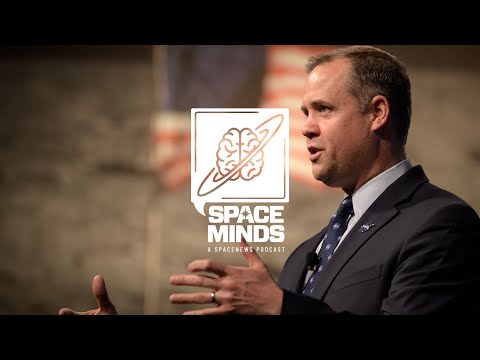
In this episode of Space Minds, host David Ariosto speaks with Jim Bridenstine, former NASA Administrator and U.S. Congressman, who oversaw the launch of the Artemis program—America’s renewed effort to return astronauts to the Moon.
Now Managing Partner of the Artemis Group, Bridenstine discusses the intersection of politics, policy, and innovation shaping the modern space race. From government shutdowns and funding instability to U.S.-China competition and the future of lunar commercialization, he shares candid insights on why America’s leadership in space depends on sustaining investment, fostering commercial partnerships, and inspiring a new generation through science and exploration.
Show notes and transcript
Click here for Notes and Transcript
Time Markers
00:00 – Episode introduction
00:27 – Welcome Jim
00:52 – What is the Artemis Group?
02:11 – The government shutdown
04:31 – Continuing resolutions and America’s strategic competitiveness
10:02 – Trying to do the big things
11:24 – The biggest structural or cultural obstacles
14:15 – China beating the U.S. to the moon
17:18 – Weaning off taxpayer dollars
20:40 – Invoking the Defense Production Act
23:46 – SpaceX delays and what winning against the Chinese looks like
26:28 – What’s the real value of the moon?
35:09 – China will exploit any gap
40:38 – Inspiring awe and curiosity in the public
Transcript – Jim Bridenstine Conversation
This transcript has been edited-for-clarity.
David Ariosto – Jim Bridenstine, former congressman and former administrator of NASA under the first Trump administration. You were the administrator who oversaw the very start of the Artemis program, which endeavors to bring American astronauts back to the Moon. You’re now managing partner of The Artemis Group. First of all, it’s great to have you on the show. But what is The Artemis Group? To provide some context?
Jim Bridenstine – The Artemis Group is an organization we started a little over a year ago. We began as a consulting firm, mostly for space companies. The intent was to provide strategic advice, help with fundraising, and business development. Over time, as President Trump came into office, many of our clients started asking us to do government affairs work, and so we expanded into that. It’s a diverse company, but at heart, we’re a space-focused consulting firm—that’s our ethos and where we want to be.
David Ariosto – You’re in Tulsa right now, but in many ways, you’re a Washington guy too. I imagine that connectivity is where The Artemis Group comes in. But I wonder, in the context of the broader space landscape, how does the government shutdown impact space companies? Especially when we talk about competitiveness and programs like Artemis—big companies can absorb it, but what about smaller suppliers?
Jim Bridenstine – There’s always pain in a shutdown, no question. But over time, people have realized these events are so common that liquidity has developed around them. When the government reopens, it pays what’s owed, so companies can often get loans or bridge financing. Still, it’s terrible for the country. The result is usually a continuing resolution, which is also bad—it funds things that may be obsolete and underfunds what we need to stay competitive. So, we go from a shutdown, which is awful, to a continuing resolution, which benefits our adversaries more than us. We’ve got real fiscal problems, yes—but there must be a better way to resolve them without shutting down the government or freezing progress.
David Ariosto – And that’s not new. Continuing resolutions have been around for decades. How does this affect how we set national priorities and plan long-term—especially compared to China, which sets and meets decades-long goals for its space program?
Jim Bridenstine – That’s the challenge we face. Ideally, Congress passes twelve appropriations bills, committees do their work, amendments get debated, and you end up with consensus. But both parties have learned to take hostages—if one side doesn’t get everything it wants, it blocks everything. That leads to filibusters, delays, and eventually these giant omnibus bills that jam everything together. It’s a terrible way to govern.
When I was in Congress, I used to say: two-thirds of federal spending is mandatory—Social Security, Medicare, Medicaid—and only one-third is discretionary. Half of that third is defense. Now, it’s closer to three-quarters mandatory. That means we’re fighting over an ever-shrinking slice of the budget. The mandatory side keeps growing because no one wants to touch it politically. So discretionary spending—including NASA—gets squeezed every year.
David Ariosto – When you’re trying to do bigger things—going to the Moon, building orbital infrastructure—what were the biggest structural or cultural obstacles inside NASA or among contractors when ushering in this new era of commercial partnerships?
Jim Bridenstine – The biggest challenge is the whimsical budgets of politicians and the changing priorities between administrations. It’s not new—we’ve seen it since Nixon canceled Apollo. We do a big thing, then cancel it, then have a gap before the next big thing. Billions get sunk into programs like Constellation or the Space Exploration Initiative, only for the next administration to scrap them. That’s unsustainable.
If we want consistency, we need to commercialize as much as possible and attract private capital that isn’t tied to political cycles. That’s how we get long-term stability.
David Ariosto – You’ve said before that the probability of beating China to the Moon is “approaching zero rapidly.” What’s behind that statement?
Jim Bridenstine – To avoid being at the mercy of shifting political winds, we have to bring in private investment. That’s why we created programs like CLPS—the Commercial Lunar Payload Services initiative. It was modeled partly after the Google Lunar XPRIZE, which no one won, and NASA’s commercial resupply and crew programs. If we couldn’t legally run a prize competition, we could still contract for outcomes—paying companies to deliver NASA payloads to the Moon. That allowed entrepreneurial firms like Intuitive Machines and Firefly to play key roles, and it gave us speed and innovation we couldn’t achieve under traditional government contracting.
David Ariosto – If you’re trying to build a commercial lunar sector that’s less dependent on taxpayer funding, how realistic is that? Can such a market sustain itself?
Jim Bridenstine – It’s partly true, but look—most of low Earth orbit is still driven by government spending, even the communications market. And that’s fine, because it built critical infrastructure. We’ll see the same in cislunar space. We’ll need communications, navigation, propulsion—all things the government will fund initially. Over time, the private sector builds on top of that foundation. That’s how dual-use systems emerge, driving costs down for taxpayers and opening access for others.
David Ariosto – You’ve suggested invoking the Defense Production Act and hinted that Artemis may need a pivot, especially since Artemis III relies heavily on SpaceX. Why is that pivot needed, and what might an alternative look like?
Jim Bridenstine – First, I’m no longer the NASA Administrator, and Bill Nelson’s doing a great job. Starship will be a transformational capability, and we need it to succeed. But if the goal is to beat China to the Moon, we also need an approach that can move faster—using more off-the-shelf technology and multiple providers. It’s not about replacing SpaceX; it’s about having redundancy and speed. We can pursue transformational systems and near-term missions at the same time.
David Ariosto – SpaceX responded, calling your comments a “paid lobbying effort to secure billions in government funding.” How do you respond to that? And more broadly—what does winning against China really mean?
Jim Bridenstine – I started The Artemis Group to help America remain the world’s preeminent spacefaring nation. Everything we do is in service of that goal. My point wasn’t to criticize SpaceX—they’re essential. But alignment matters. If policymakers are demanding speed and contractors are delivering long-term architectures, there’s a gap. I’m advocating for both: near-term capability and long-term transformation. That’s not either/or—it’s both/and.
David Ariosto – Let’s talk about the Moon itself. Beyond flags and footprints, what’s the real value? Are resources like helium-3, reduced gravity, or its role as a scientific outpost what truly matters?
Jim Bridenstine – Absolutely. Helium-3 could be vital for fusion or as a coolant for quantum systems. The Moon also provides reduced gravity ideal for research and a launch platform for deep space. And in the geopolitical context, China’s investments there—supercomputers, solar arrays, AI systems—show it’s not just about exploration. It’s about influence, economics, and technological leadership.
David Ariosto – Given China’s expected deployment of on-orbit supercomputers and large solar arrays tied to AI and energy, is this competition really about the Moon—or something broader?
Jim Bridenstine – Much broader. NASA is one of America’s greatest tools of power. Through the “DIME” framework—diplomatic, informational, military, economic power—it strengthens all four. Diplomatically, NASA builds partnerships and goodwill worldwide. Informationally, every Mars landing or lunar mission broadcasts American capability and ideals globally. Economically, everything from GPS to microgravity research drives innovation, industry, and jobs.
China understands that. They use space to showcase their system’s superiority. When we land on Mars, it’s on every newspaper—even in places like Tehran. That’s soft power at work. The same is true for microgravity research—pharmaceuticals, advanced materials, 3D-printed organs. If we let the ISS deorbit without a successor, we hand 20 years of progress to China. We can’t afford another gap.
David Ariosto – We’ve seen these pushes and gaps in American space policy before. Are we at risk of another one that China could exploit?
Jim Bridenstine – Yes, absolutely. When the ISS retires, if we don’t have commercial stations ready, China’s Tiangong becomes the only platform in orbit. They’ll use it for science, materials, even hypersonic research. That’s why we can’t pause—we need continuous human presence in low Earth orbit. If we lose that, we lose leadership.
David Ariosto – Basic science funding has been declining for decades in the U.S., while it’s increasing in China. If you were back at NASA, what bold but achievable policy actions would you take to strengthen U.S. leadership?
Jim Bridenstine – First, you can’t say we’re going to “dominate space” and then cut NASA’s budget by 25 percent. NASA’s budget is a third of one percent of the federal budget—cutting it doesn’t fix the deficit but does real damage to our future economy. We need stable appropriations and support for basic research.
Einstein’s work on relativity, funded by government science programs, made GPS possible decades later. Nobody in the 1930s predicted navigation satellites or cell phones, but that basic science created them. The James Webb Space Telescope will do the same—it’s expanding our understanding of physics in ways that could define the next 50 years.
David Ariosto – My father, who’s not a space guy, keeps sending me James Webb images. Do you think NASA’s cultural influence—its ability to inspire awe—is part of its real power?
Jim Bridenstine – Completely. The psychological impact of NASA’s achievements can’t be overstated. When people see those Webb images, or a lunar landing, it reshapes how they see the world—and it inspires kids to pursue STEM. That’s not just feel-good; it’s national strength. If we want to lead, we must keep doing things that are stunning—returning to the Moon, going to Mars, pushing science forward. Science has always been power, and understanding it gives you the edge. Always has, always will.
David Ariosto – Jim Bridenstine, former congressman, former NASA administrator, and now managing partner of The Artemis Group—it’s been such a pleasure having you on the show.
Jim Bridenstine – Thank you, David. My pleasure.
About Space Minds
Space Minds is a new audio and video podcast from SpaceNews that focuses on the inspiring leaders, technologies and exciting opportunities in space.
The weekly podcast features compelling interviews with scientists, founders and experts who love to talk about space, covers the news that has enthusiasts daydreaming, and engages with listeners. Join David Ariosto, Mike Gruss and journalists from the SpaceNews team for new episodes every Thursday.
Watch a new episode every Thursday on SpaceNews.com and on our YouTube, Spotify and Apple channels.
Be the first to know when new episodes drop! Enter your email, and we’ll make sure you get exclusive access to each episode as soon as it goes live!
Space Minds Podcast
"*" indicates required fields
Note: By registering, you consent to receive communications from SpaceNews and our partners.