

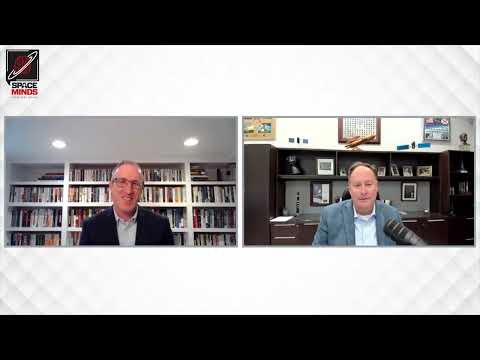
In this week’s episode of Space Minds, host Mike Gruss speaks with Robert Lightfoot, president, space at Lockheed Martin and former NASA associate administrator.
Lightfoot takes us inside the company’s large space portfolio — from building weather and GPS satellites to advancing missile defense and next-generation interceptors. He shares how Lockheed is adapting to faster, more agile ways of working, explores the evolving economics of space, and reflects on how the U.S. can protect critical assets in an increasingly contested domain. Plus, a look ahead to ambitious milestones like the Artemis moon missions and a potential 2028 space-based interceptor test.
Show notes and transcript
Click here for Notes and Transcript
Time Markers
00:00 – Episode introduction
00:23 – Welcome
00:36 – Overview of Lockheed Martin Space
03:51 – Current industry landscape
06:43 – Golden Dome big picture
12:29 – Acquisition reform
15:04 – How Lockheed has changed
17:36 – Cultural change
18:54 – Exploration role and evolving thinking
23:36 – Insights from civil to commercial
28:20 – Leading up to 2028
Transcript – Robert Lightfoot Conversation
This transcript has been edited-for-clarity.
Mike Gruss – Hello, I’m joined today by a familiar name to our audience, Robert Lightfoot, who is the president of Lockheed Martin Space. He spent 29 years at NASA, and we’re excited to have him here today. Robert, before we start, why don’t you give me a little bit of an overview about everything that is Lockheed Martin Space, and help set the stage for a little bit about what we’re going to be talking about today.
Robert Lightfoot – Sounds good. Hey, Mike, thanks for having me. Really appreciate the opportunity. Super excited about doing this with you. I think this will be fun. We’ll have a little fun today going through it. Let me kind of give you the overview for Lockheed Martin Space—what we are, what we do—at a pretty high level.
I have three business units inside my group, and one of them is commercial, civil space. So we do the weather satellites for NOAA. We do some of the science missions for NASA, and of course we have Orion, the human spaceflight mission that happened here in the first part of 2026, so we’re excited about that mission and moving forward. That’s my commercial, civil area. We do some work internationally in there, but not a lot.
I have an organization called Strategic and Missile Defense. You might wonder, why do I do missiles in space? Well, it’s because my missiles actually go to space, right? So they’re that kind of a system. We do the fleet ballistic missile, which is one part of the nuclear triad for the country—the Trident D5 which flies out of submarines. That’s probably our anchor tenant. We also do the next generation interceptor here. This is the defense system for MDA that sits in Fort Greely, Alaska. We’re working on the next generation of that right now.
Hypersonics is done in that area—a lot of work around what we call conventional prompt strike and long-range hypersonic weapon. And then we do reentry vehicles there. That’s kind of our crown jewel—these things go to space and they’ve got to come back into the atmosphere.
Then I’ve got an organization called National Security Space. It’s kind of a combination of what we do for the intelligence community and also for the Space Force. This is where I do our GPS satellites. We do overhead persistent infrared satellites. We do work for the Space Development Agency—the different proliferation of smallsats we’re doing there. We also do a ton of classified stuff that we won’t get into here, but that’s kind of my portfolio.
And then I recently created a group called Ignite. Ignite is kind of my rapid capabilities office. It’s where I do my tech demos and allow my team to actually operate outside of the normal command media—outside of the normal acquisition process. How do I retire risk that I can then bring forward to the customer and say, “I’ve already flown this; it’s already been in space”? That’s risk we’ve retired, and we kind of cherry-pick where we do that in terms of a big-bet mentality. We’ve done two or three missions already, and this is something we’re doing again to retire that risk, so that when we go after the larger programs of record, we’re ahead of the curve.
So that’s kind of my business in general—about 22,000 people, 38 sites all over the world. It’s a fun time to be in this business.
Mike Gruss – It’s a big job. And like you said, it’s a fun time. I wanted to start by saying I think that my impression has been that generally the space business is one of optimism, that people are generally optimistic about where the space business is going. Obviously we’re in a moment of change right now. There are a lot of new opportunities out there. People are thinking differently about every aspect of space right now. But you’ve done this for a long time—how do you evaluate where we are right now, and maybe how is this different from where we’ve been in the past?
Robert Lightfoot – Yeah, it’s a great question. I think, you know, my perspective—almost 40 years in this business now—what I find is that space inherently is just exciting for people, regardless of what you’re doing. A lot of it is complex, it’s hard, it hasn’t been done before. Those kinds of things excite a workforce. It excites people to be involved in solving problems that, frankly, you couldn’t solve by yourself—but you’re part of a larger team that solves some complex issue we have to deal with.
What’s different now is that we look at the life cycle of space. We have a phrase here at Lockheed Space: explore, connect, and protect.
If you look at any kind of human history, it starts with exploration—think about people finding the U.S., Lewis and Clark, all of that. Exploration is where excitement starts. If you do it right, suddenly you have the ability to build a business. It becomes an economic discussion—there’s an economic advantage to that. And then you’ve got to protect it, just like we protect shipping lanes here on Earth.
The space environment also allows us to connect in a way that’s unique—we can do ubiquitous communication from space. I don’t necessarily need a cell tower; I can do this from orbit. That leads to a commercial piece.
So the excitement and opportunity of space is what people are grabbing onto. The other side of that, of course, is that it’s now a contested environment—it’s become a warfighting domain. We have a Space Command now, a Space Force, which didn’t exist when I first started. So while we want to maintain exploration and peaceful use of space, we have to protect that and make sure it stays an opportunity for our nation and for industry.
Mike Gruss – One of the ways that protection has come up a lot, especially these last maybe nine or ten months, has been Golden Dome. There’s a whole range of options on the table right now. How are you talking about this, or how are you seeing this work—technically, contractually? What might Lockheed’s role be? Talk to me from a big-picture perspective.
Robert Lightfoot – Yeah, well, that’s where you have to start—with the big picture. I start with the threat. Historically, as a nation, we’ve had the advantage—or at least the mental comfort—of two oceans separating us from a lot of threats, which can give you a false sense that we’re okay. It’s hard to get to us. But now our adversaries have the capability to reach out and touch us in ways they couldn’t 20 or 30 years ago—whether that’s Russia or China. The threat is real.
Then comes protection. Look at systems like THAAD, Patriot, the big radars—we deploy those internationally. But how do we protect our domestic capability—protect the homeland? It’s a big job, a large effort. It’s an and, not an or. It’s going to take the whole nation.
Mike Gruss – When you say and instead of or, what does that mean?
Robert Lightfoot – It means it’s going to take all of us. It can’t be one company or another; it’s going to take everyone coming together. I’ve been using a “moonshot mentality” with my team—like Apollo. Back then, industry and government came together under one hat, one mission. No single company can do this alone. We’ve got to bring the best of breed from across the nation and move fast.
Speed is going to be something we haven’t seen before. In some cases, the government is even moving faster than industry, which no one would believe, but I’m watching it happen. They’re using a risk-based approach: move fast where you can without taking ridiculous risk.
This effort will depend on how the architecture comes out, but it’ll be large. It’ll take all of us—old tech, new tech—bringing it together to face this threat.
Mike Gruss – There’s been this idea that existing capabilities could fall under the Golden Dome umbrella to make up this system. What’s one part of Golden Dome you think isn’t getting enough attention?
Robert Lightfoot – I think until the whole architecture gets rolled out, it’s hard to say. There’s a munitions ramp-up happening regardless of Golden Dome, but Golden Dome will benefit from it. The interesting part will be the space-based perspective—space-based interceptors for missile defense.
People say, “We tried that in the ’80s and it didn’t work.” The tech is very different now. We have much more capability. The challenge will be integrating existing capabilities in new ways. The “secret sauce” will be using proven technology differently—minimizing new development. The new stuff will be what we do in space.
Mike Gruss – And you’re still eyeing a potential 2028 space-based interceptor test, correct?
Robert Lightfoot – Yeah, I think we’ve got the tech to do that. We just need to get going—the clock’s ticking. There are several of us in industry ready to move, and the government’s ready too.
Mike Gruss – When folks in government talk about acquisition reform—doing things faster, cheaper, more efficiently—how do you square that with Lockheed being such a dominant player? How do you see that movement?
Robert Lightfoot – The way I think about it is that there’s value in the legacy mission knowledge we bring as a long-standing prime, but there’s also value in what we’re learning from new entrants in the business. We’re having to change our operating models, adjust and adapt.
A lot of that adjustment comes with the government changing its requirements. I build what they ask for—it doesn’t take me five years because I want to, but because of the complexity they specify. Could we use less complex spacecraft? Absolutely. It requires working shoulder-to-shoulder with the customer—not throwing things over the fence.
This can’t be transactional—it has to be collaborative. We need to discuss what’s driving cost and schedule. The perfect can’t be the enemy of good enough. The goal is to get hardware on orbit faster, even if it’s not perfect.
Mike Gruss – Can you give an example of how you’ve changed because speed is driving everything?
Robert Lightfoot – Sure. A couple of examples. When the Space Development Agency came along with its proliferated architecture of smaller satellites, we had to adapt. We were used to building big, bespoke satellites. Now, we needed to print out copies—common designs across tranches.
So, we bought a bus company, Terran Orbital. They have a common bus—we don’t mess with it, we design around it. We also built our “Speed Center,” a production line for smallsats. At any time, we have 26 or 27 satellites in different stages of assembly—totally new for us.
And we created Ignite, our rapid capabilities organization, to retire risk faster. Our LM 400 bus, a midsize “refrigerator-size” bus, went from concept to launch in under two years—which for us is fast. That’s been a cultural change.
Mike Gruss – Terran Orbital—that’s a very different culture from a traditional Lockheed Martin culture. What have you learned there? How do you integrate that?
Robert Lightfoot – They’re integrated now as a wholly owned subsidiary. What we’ve learned is that having a common, repeatable bus is a huge advantage. It removes some of the temptation for engineers to over-customize. We’re constraining designs a bit more—going toward a common product mentality so we can reuse components across missions. It reduces engineering cost and moves us faster.
Mike Gruss – I want to shift to that “explore” mindset you mentioned. How do you see Lockheed Martin’s role in lunar and Mars exploration? And how has your thinking evolved over the last year or two?
Robert Lightfoot – We want to be part of those opportunities. We can help NASA, NOAA, and others. We’re super excited about flying humans again—to the Moon. The Artemis II crew has been with our team a lot, and there’s nothing like having the crew talk to the workforce. The key isn’t just taking them to the Moon—it’s bringing them home.
What’s changed for us is exploring new ways to approach missions. Take Mars Sample Return. That program’s cost ballooned to an unacceptable level. I asked my team: with no requirements other than “go get the samples and bring them home,” how would you do it today? We built an architecture to do it for under $3 billion, compared to $8–9 billion.
We even proposed doing it firm-fixed price. I’m sure there are assumptions NASA would push back on, but it’s a better approach. It’s about setting mission requirements, not dictating the “how.”
We learned this from NASA’s commercial cargo and crew programs—define the mission, not the design. Similarly, we’re exploring how Orion could be offered as a service after Artemis V—Lockheed operating it with NASA in a supporting role, like commercial crew. It’s early, but worth discussing.
Mike Gruss – You were on the other side of the table for a long time, in government. What have you learned switching seats? How do you think differently now about how both sides can work together?
Robert Lightfoot – What’s struck me most is that even though we have the Federal Acquisition Regulation, different agencies apply it differently. On the industry side, I see the financial impact of government investment decisions. What’s the return on investment? What’s the carrot?
Historically, acquisitions became too transactional—focused on legal terms rather than mission. We need shoulder-to-shoulder partnerships.
When I worked on the Space Shuttle Program, you could walk into a meeting and not know who anyone worked for—NASA, Lockheed, Boeing—it didn’t matter. The badge said “Shuttle.” The mission was the focus.
Now, we’ve drifted too far into paperwork and compliance. Some agencies do collaboration beautifully, others not so much. We’ve got to be stubborn and keep pushing for true partnerships. It’s not about breaking rules—it’s about working within them to move faster.
Looking back, I realize there were things I could’ve changed in government that would’ve made industry’s job easier—but I didn’t know the burden at the time. A lot of former government folks say the same thing after joining industry.
Mike Gruss – We’re just about out of time. You just mentioned 2028—what does success look like for you between now and then? What has to happen in “explore” and “protect” for you to feel like you’re making a difference?
Robert Lightfoot – On the “connect” side, getting key satellites on orbit—like military SATCOM and GPS III-F — is critical. By 2028, I expect those to be flying. The GPS III-F line includes additional protections the military needs.
For “protect,” I hope the proliferated architectures are functioning so warfighters depend on them. For “explore,” I expect we’ll have footsteps back on the Moon. Artemis III will be fully operational, and Artemis II will have flown.
We’ll also be preparing science missions and refining risk management—taking smart risks, not being risk-averse. That’s essential to protect the homeland and advance space capabilities.
At a recent panel, competitors and partners all said the same thing: we’re ready to get after this. The challenge ahead is integrating command and control—C2 of C2s. It’s complex, but that’s the kind of hard problem that excites us. It’s an opportunity to bring together the nation’s best technology to confront real threats and push innovation forward.
Mike Gruss – Well, that seems like a great place to stop. Robert, thanks so much for joining us.
Robert Lightfoot – Thanks, Mike. Appreciate it. Great conversation.
About Space Minds
Space Minds is a new audio and video podcast from SpaceNews that focuses on the inspiring leaders, technologies and exciting opportunities in space.
The weekly podcast features compelling interviews with scientists, founders and experts who love to talk about space, covers the news that has enthusiasts daydreaming, and engages with listeners. Join David Ariosto, Mike Gruss and journalists from the SpaceNews team for new episodes every Thursday.
Watch a new episode every Thursday on SpaceNews.com and on our YouTube, Spotify and Apple channels.
Be the first to know when new episodes drop! Enter your email, and we’ll make sure you get exclusive access to each episode as soon as it goes live!
Space Minds Podcast
"*" indicates required fields
Note: By registering, you consent to receive communications from SpaceNews and our partners.