

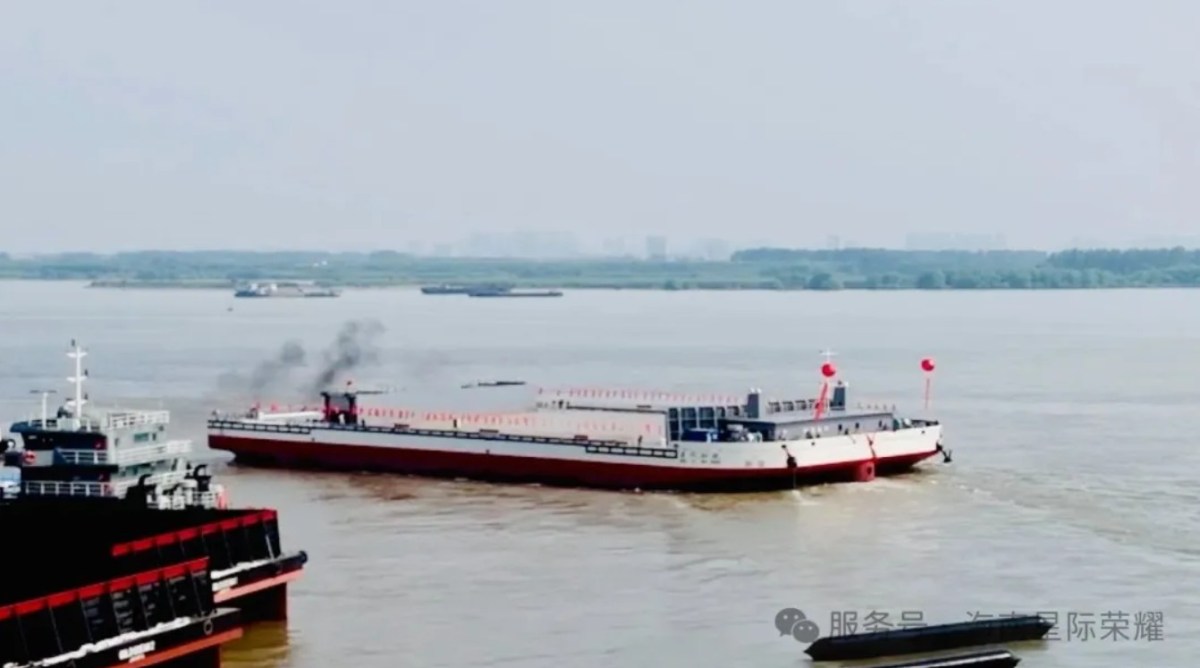
HELSINKI — Chinese launch startup iSpace has launched the nation’s first rocket recovery ship, marking a major step toward offshore reusable rocket operations.
The ship, named Xingji Guihang (“Interstellar Return”) was launched in Yangzhou, Jiangsu province Aug. 5 and will enable offshore recovery of medium- and large-scale reusable rockets. It is China’s first drone vessel for recovering rocket stages, marking a milestone in hardware development. It follows four autonomous spaceport drone ships developed by SpaceX.
The Interstellar Return was designed specifically for recovering the first stages ofiSpace’s Hyperbola-3 methane-liquid oxygen rocket. The company, full name Beijing Interstellar Glory Space Technology Ltd., plans to conduct a test flight of the launcher by the end of the year.
The vessel, approximately 100 meters long and 42 meters wide with a 40-by-60-meter recovery deck, can operate autonomously using a DP2 dynamic positioning system. This allows precise capture of rocket stages in Sea State 4 and stable navigation in Sea State 5, according to iSpace, according to an iSpace statement. While designed for the Hyperbola-3, it can also accommodate recovery of other medium- and large-scale reusable rockets.
The vessel is now set for testing, after which it is scheduled to arrive at the island of Hainan in September for large-scale joint sea drills and other integrated testing. The first Hyperbola-3 will launch from the Hainan commercial space launch center on the island at a later date.
“As China’s first rocket recovery ship, the Interstellar Return has explored and established a new standard integrating the aerospace and shipbuilding industries, setting a model and leading the way for subsequent rocket recovery ship construction,” iSpace chairman Peng Xiaobo said in a speech.
The ceremony followed a successful return-to-flight for iSpace July 29 with the Hyperbola-1, having suffered a series of failures of the solid propellant rocket. Despite the setbacks and checkered launch record, in March iSpace announced Series D funding worth “several hundred million yuan” (100 million yuan = $13.8 million).
Interstellar Return is part of a broader infrastructure build-out in Hainan for iSpace’s reusability program, including use of the commercial spaceport’s launch facilities, and a dedicated launch vehicle assembly, testing, and reuse factory, which is part of the wider Wenchang International Aerospace City initiative.
The development is part of China’s wider efforts to expand its launch infrastructure and acquire reusable launch capabilities. A number of potentially reusable commercial and state-owned rockets could see test flights before the end of the year, including Zhuque-3 (Landspace), Tianlong-3 (Space Pioneer), Kinetica-2 (CAS Space), Pallas-1 (Galactic Energy), Gravity-2 (Orienspace), Hyperbola-3, Nebula-1 (Deep Blue Aerospace) and the Long March 12A (CASC), indicating a crowded field of competitors for limited launch contracts.
Reusable rocketry could help China increase its launch cadence and aid the construction of the country’s planned megaconstellations.