

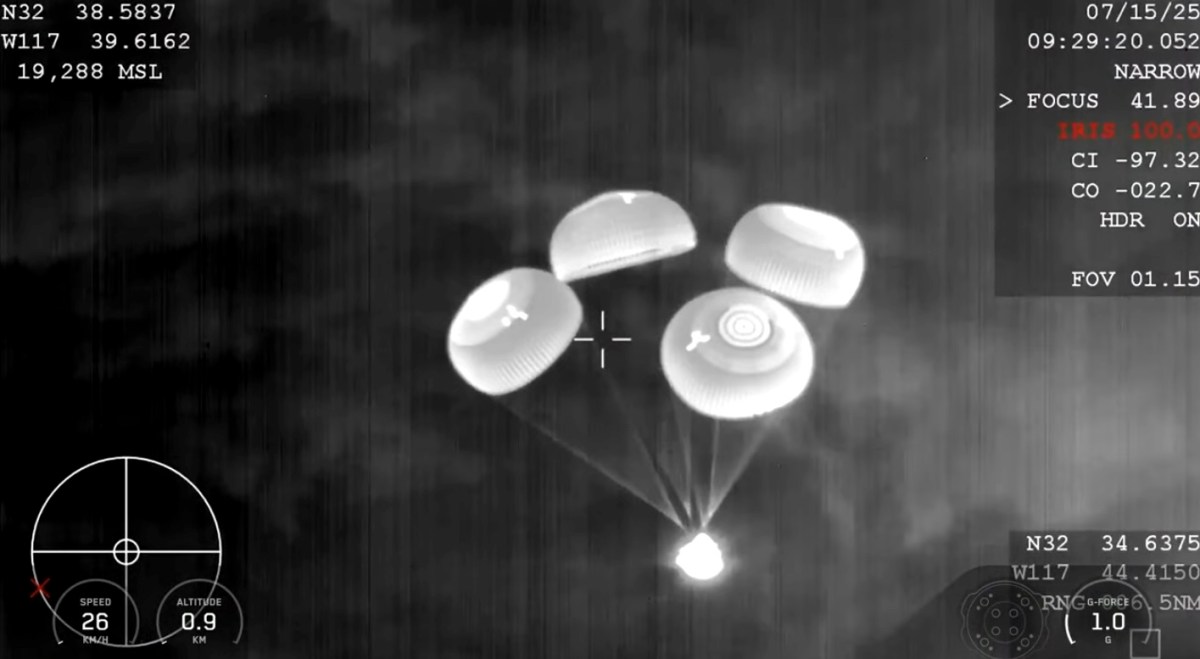
WASHINGTON — A SpaceX Crew Dragon spacecraft safely splashed down off the California coast early July 15, wrapping up a nearly three-week private astronaut mission to the International Space Station.
The Crew Dragon spacecraft Grace splashed down in the Pacific Ocean west of San Diego, California, at 5:31 a.m. Eastern. Recovery teams moved the capsule onto a recovery ship and the four-person crew exited the spacecraft nearly an hour after splashdown.
The splashdown concluded the Ax-4 private astronaut mission by Axiom Space. The mission launched June 25 from the Kennedy Space Center, docking with the International Space Station the next day. The spacecraft undocked from the station at 7:15 a.m. Eastern July 14 ahead of reentry and splashdown.
Ax-4 was commanded by Peggy Whitson, a former NASA astronaut now working for Axiom Space. This was her fifth flight after three long-duration missions for NASA and the Ax-2 mission for Axiom in 2023.
The other members of the Ax-4 crew were Indian astronaut Shubhanshu Shukla, serving as pilot, and mission specialists Sławosz Uznański-Wiśniewski of Poland and Tibor Kapu of Hungary. Shukla and Kapu were flown by their national governments while the European Space Agency supported the flight of Uznański-Wiśniewski, who ESA selected as a reserve astronaut in 2022.
The crew performed more than 60 experiments during their two and a half weeks on the ISS, more than any of Axiom’s three previous missions to the station. They also engaged in educational outreach activities.
The hardest part of the Ax-4 mission appeared to be getting it launched. The mission was scheduled to launch earlier in the spring, but NASA and SpaceX agreed early this year to reassign the Endurance spacecraft originally planned to fly Ax-4 to the Crew-10 NASA crew rotation mission that launched in March. Ax-4 was then assigned a new Crew Dragon spacecraft, which the Ax-4 christened Grace after its launch.
A launch in late May was postponed to early June to allow more time to complete checks of the Crew Dragon, and weather and a liquid oxygen leak in the Falcon 9 booster led to additional delays.
A much longer delay came after NASA said it wanted to work with Roscosmos to study a “new pressure signature” in a Russian module after cosmonauts worked to repair small cracks seen in one part of it. NASA later said a small but long-running air leak in that module had stopped, but the agency was not sure if that was masking a leak in a hatch seal.
At a July 10 briefing about the upcoming Crew-11 mission to the ISS on another Crew Dragon, NASA officials said they now believe the leak, located in a part of the Zvezda service module called PrK, has effectively stopped. “Since then, the PrK has been holding” air pressure, said Bill Spetch, operations integration manager for the ISS at NASA. “Its pressure has been very steady.”
The splashdown wraps up the fourth private astronaut mission (PAM) to the ISS sanctioned by NASA as part of its low Earth orbit commercialization strategy. The flights are designed to give companies experience in human spaceflight operations ahead of the transition to commercial space stations, whose development NASA is also supporting. Axiom is one of the companies with plans to develop commercial stations.
All four of those PAMs have been flown by Axiom Space using Crew Dragon spacecraft. NASA is currently competing the next two PAMs, in 2026 and 2027. While Axiom won the first four with little or no competition, it’s expected to face stronger competition for the next two, with commercial space station developer Vast announcing its intent last year to compete for those flight opportunities.