

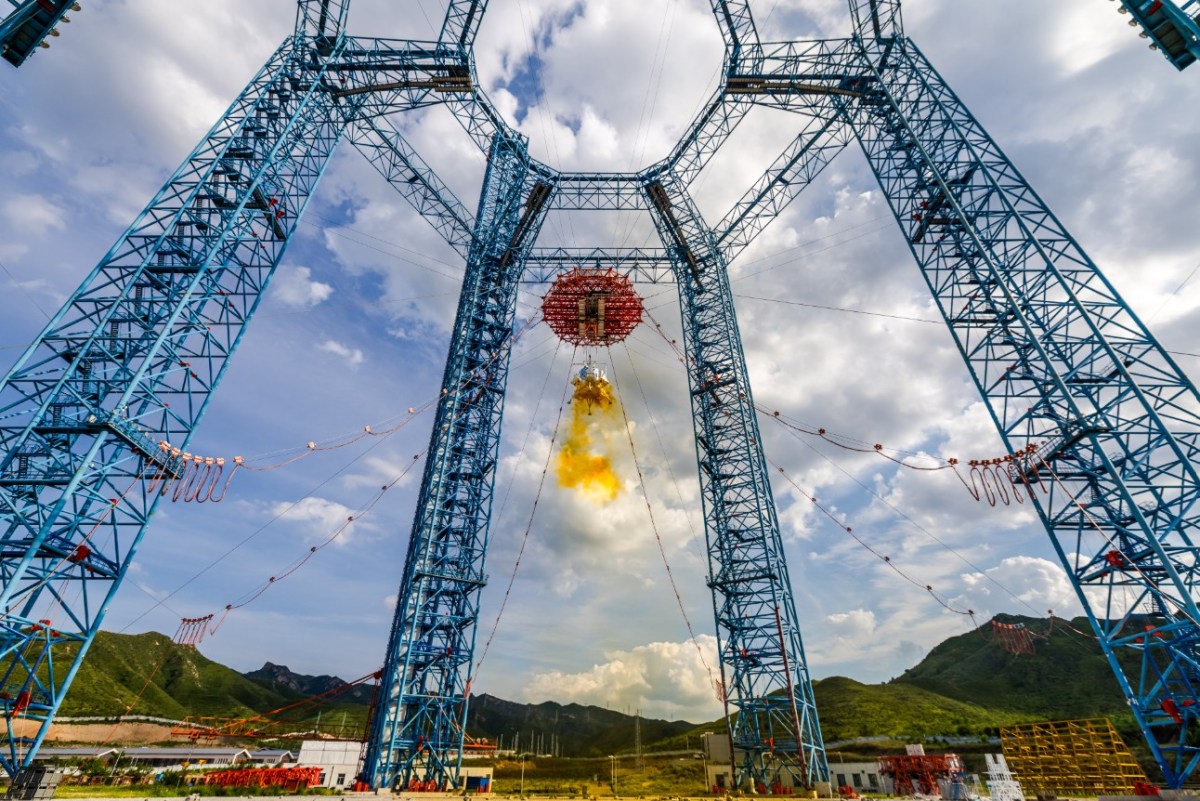
Espoo, FINLAND — China has completed an integrated landing and ascent test of its Lanyue lunar lander, marking a major milestone in its crewed moon landing program.
The first integrated landing and ascent test of the Lanyue (“embracing the moon”) crewed lunar lander took place in Huailai County in Hebei Province, north China, Aug. 6, simulating a landing on the moon and a subsequent takeoff, China’s human spaceflight agency announced Aug. 7.
The test validated the Lanyue’s landing and takeoff systems, control systems, lunar contact shutdown procedures, and the compatibility of interfaces between subsystems, including guidance, navigation and control (GNC) and propulsion, according to a CMSEO statement.
Footage from the test shows the four-legged lander under thrust, with a yellow plume suggesting the use of a nitrogen tetroxide-based oxidizer, likely in combination with hydrazine, as used for China’s robotic Chang’e landers. The facilities earlier hosted landing tests for China’s Tianwen-1 Mars mission.
The successful test marks progress in hardware testing for the crewed moon ambitions and another step towards China’s planned goal of landing astronauts on the moon before 2030.
The Lanyue lunar lander consists of a propulsion module and landing module and is designed to transport two astronauts between lunar orbit and the moon’s surface. The propulsion stage will be used for the descent before separating from Lanyue and undergoing a controlled impact. Lanyue will then carry out the final stages of descent, as well as the ascent back into lunar orbit.
The lander is also capable of carrying a lunar rover and scientific payloads. Lanyue has undergone a series of tests so far, according to space officials involved in the project.
“For instance, during the launch phase, we need to verify its launch payload. So we conducted large-scale mechanical tests to ensure a smooth transition in the extremely complex environment during the launch,” Huang Zhen from China Aerospace Science and Technology Corporation (CASC), told China Central Television (CCTV).
“The lander will also orbit the moon for a long period, so we performed many thermal tests to ensure that it can withstand the thermal environment of the cislunar space,” Huang said.
Huang added that the lander has been designed with redundancy in mind. “The lander has multiple engines that are arranged in a redundant configuration to backup each other. In the event of a failure of any single engine, [the remaining engines] can safely bring the astronauts back to the lunar orbit, enabling them to return home on Earth,” Huang said.
CASC is China’s main space contractor and is building the various elements needed for the country’s crewed lunar landing plans.
Other key elements of China’s moon program are the Long March 10 rocket along with the Mengzhou crew spacecraft, a lunar EVA spacesuit and an unpressurized surface rover.
Two Long March 10 launches will be used to get astronauts to the moon and back. One will launch a crew spacecraft, named Mengzhou, and another will launch the lunar lander stack, named Lanyue. The two spacecraft stacks will rendezvous in lunar orbit.
Last month China appeared to have successfully carried out structural tests on the Long March 10 and is progressing with its launch facilities at Wenchang spaceport on Hainan island. A test flight of a single stick version of the rocket, the Long March 10A, could take place as soon as next year.
In June, China carried out a pad abort test for the Mengzhou crewed spacecraft, with an in-flight escape test at maximum dynamic pressure expected later in the year.
China’s efforts are taking place amid the backdrop of NASA’s own lunar crewed landing ambitions. The four-person Artemis 2 mission to fly around the moon and back is scheduled to launch no later than April 2026. The Artemis 3 moon landing mission is currently scheduled for mid 2027.